
Global Care Packs
Living Learning Experiences

Learning comes to life through
shared experiences in real places
Living Learning Experiences bring together the narrative and experiential learning pathways across three programs:
-
Teachers and Educators - CARE Education
-
Regeneration Stewards - Knowledge Systems Synthesis
-
Community Pioneers - Prosocial Community
Education Foundations for Thriving Futures
The foundation book for Thriving Futures 2100 programs
The book introduces the River System of Human Time, a narrative framework for exploring humanity’s journey from our shared evolutionary past into the complex realities of the Anthropocene. It follows the development of human capacities, knowledge systems, relationships and ways of organising life, asking how the choices made across generations have shaped the world we inherit today.
At its centre is the idea of Regeneration Transitions: learning how to maintain, renew and strengthen the conditions that enable life to thrive across generations. The book explores this through three interconnected dimensions of Nature, Prosocial and Universal Connection, bringing together research, different knowledge traditions, lived experience and the practice of tracking to investigate relationships between people, communities and the living world.
Education Foundations for Thriving Futures provides the conceptual foundation for the Thriving Futures 2100 learning programmes. It presents education as an intergenerational journey that combines narrative and experiential learning, helping people develop the knowledge, capacities, relationships and practical experience needed to participate thoughtfully in Regeneration Transitions.

The book introduces the River System of Human Time and the educational foundations behind Thriving Futures 2100 and its approach to Regeneration Transitions. To order a copy, click here.
Global Care Packs Learning Domains


The Free Online Introduction Course
Discover the ideas, people, and learning pathways behind Thriving Futures 2100 and Global Care Packs through a short introduction that combines storytelling, practical awareness skills, and a simple experiential activity.
Meet the initiating team, explore the foundations of the narrative and experiential learning paths, and take your first steps into a learning journey focused on thriving and regenerative futures.
Experiential Place Based Programs


Festival 2100
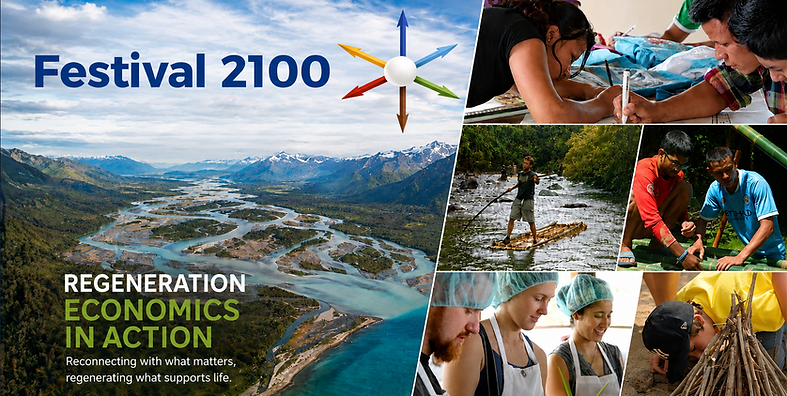
Where the learning comes together
Festival 2100: Regeneration Economics in Action is a travelling living learning experience that brings the River System of Human Time to life. Schools and other visitors journey through five experiential learning areas, exploring how humans have lived, learned, cooperated and organised their societies and economies, and the regeneration transitions that could shape the future.
Festivals take place in different locations around the world, wherever possible beside a river or within a living landscape. Global Care Packs participants join the Festival as trained mentors, working alongside the core Festival team and local communities to turn learning into shared experience and action.